Friday, October 24, 2008

Auschwitz-Birkenau Concentration Camp

If you are planning a visit to Krakow it is imperative to leave yourself time for a day trip to visit Auschwitz-Birkenau Concentration Camp. Located 50 kilometers west of Krakow (in a suburb of Oswiecim) sits the remains of Nazi Germany's largest concentration camp, Auschwitz-Birkenau

It is estimated that the Nazi's killed 1.1 million people at the camp during two and a half years of murderous operation.

Leaving Krakow early in the day is important in order to have enough time to explore Auschwitz-Birkenau. On a three and a half hour tour of Auschwitz-Birkenau you have the chance to visit the wooden baracks, crematoriums and gas chambers, as well as powerful exhibits that display belongings of the camp's victims such as eyeglasses, luggage, shoes and clothing (including small children's and baby clothes).

I found two exhibits in particular to be most astounding. First, there is an exhibit that contains roughly 7,000 kilograms (15,400 lbs) of human hair cut from an estimated 140,000 victims. This only accounts for a small fraction of the victims -- the rest is said to have been destroyed or sent to the Alex Zinc Company to be made into various products (including clothing, blankets and womens stockings). Secondly, there is an exhibit that contains a large heap of artificial legs and crutches. Our tour guide explained that a great number of the victims who had artificial legs were likely injured during WWI. These men could have very well fought alongside the men that were now Nazis.

The final photograph is of what is known as "The Black Wall" this is where thousands of political prisoners, mostly Polish resistance fighters were executed by gunshot at close range.
It is nearly impossible to process what you see at Auschwitz-Birkenau and it can be an extremely emotional journey for many visitors. However, the importance of visiting such a place cannot be overlooked. As Elie Wiesel writes, "I decided to devote my life to telling the story because I felt that having survived I owe something to the dead, and anyone who does not remember betrays them again."


Thursday, October 23, 2008

Statues Around Prague

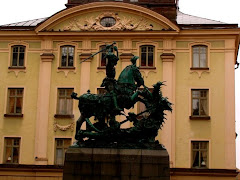
Along with architecture, Prague has some of the most beautiful statues in the world. The Charles Bridge is lined with statues (that depict biblical scenes), statues are carved into buildings and are the centerpieces of every square.

Below are a few of my favorite photographs that I took of statues throughout Prague.


Prague Castle

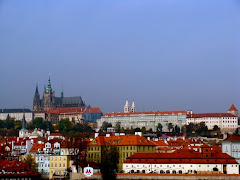
When visiting Prague my friends and I climbed up to the Prague Castle. Prague Castle is one of the largest castles in the world and surely, one of the most remarkable European sites to visit.

The history of the Prague Castle dates back to roughly 870 when the Church of Our Lady was first built. The views of the city are incredible from the castle.

Be sure to allow at least 2-3 hours to climb to the castle and to explore the inside of the cathedral and castle grounds.


Prague Food: Kampa Park

While in Prague I was able to eat some fabulous food. My favorite dining experience was at Kampa Park.

Hailed as one of Prague's best restaurants the view is to-die-for. Located at the foot of the Charles Bridge, Kampa Park has a variety of seating options including a beautiful patio that fills up quickly during the summer.

I splurged and had poached lobster on top of a bed of risotto with a vanilla foam. There are reasonably priced options on the menu though (for the student traveler). If you plan for one expensive dinner while in Prague, I recommend Kampa Park.


The Churches of Prague

Throughout Prague churches and cathedrals dominate the skyline. One of the most visible churches is St. Vitus Cathedral which is located in the Prague Castle complex.

I found visiting St. Vitus Cathedral to be overwhelming. After all, it took nearly six centuries to complete building the Gothic masterpiece.

St. Vitus is the largest temple in Prague and houses the royal tombs of Czech kings and queens as well as patron saints.

Also pictured in the last two photographs are St. George's Basilica and St. Nicholas Church at Malostranske Namesti, respectively.


Prague at Night

Prague is a city that completely transforms at night. The frequent fog combined with foot-lit castles and cathedrals is beautiful and almost eerie.

If you are interested in photography or getting impressive pictures of your travels through Europe be sure to photograph Prague at both day and night -- different aspects of the architecture truly shine at night!